What drives real innovation: fixes or fresh starts?
Every day, businesses lose momentum not because they lack ideas but because they are chained to legacy systems that can’t keep up, with slow releases, rigid workflows, aging tech stacks, and customer experiences that feel stuck in the last decade.
Greenfield development offers the “reset button” organizations have been waiting for by removing technical debt and providing a blank canvas to design cloud-native, AI-enabled, future-ready digital experiences from the ground up.
The potential payoff is substantial, as companies that blend innovation with sustainable digital transformation could generate up to $3 trillion in annual value by 2030 (DigitalDefynd).
This article reveals why greenfield development is becoming the preferred strategy for forward-thinking organizations, exploring its advantages, challenges, a case study, and the emerging trends shaping modern digital systems.
Greenfield Development: A Fresh Start
Greenfield development refers to the creation of software applications entirely from scratch, with no dependence on pre-existing systems. Unlike brownfield projects, which involve updating or expanding legacy systems, greenfield projects are free from technical debt and legacy constraints.
This approach gives organizations the freedom to craft scalable architectures, modern UX/UI designs, and flexible integrations tailored to business needs. However, this freedom comes with responsibility. Success requires disciplined planning, robust governance, and clearly defined business objectives.
Ultimately, greenfield development is not just a technical strategy; it is a mindset that reshapes how organizations approach innovation and transformation.
Why Greenfield Development Is Essential for Digital Transformation
Digital transformation (DX) has evolved beyond adopting new technologies. Today, it means rethinking processes, reinventing customer experiences, and exploring new digital revenue models. Greenfield development enables organizations to build agile, cloud-native ecosystems that fully leverage modern capabilities such as AI, microservices, IoT, and automation from day one.
By starting fresh, organizations gain the agility to adapt quickly to market demands, launch new features faster, and scale seamlessly as their business grows, without the friction of outdated systems or inherited workflows.
In short, greenfield development equips organizations with the speed, resilience, and flexibility needed to thrive in a constantly shifting digital landscape.
Greenfield vs. Brownfield: Making the Right Choice
Understanding the distinction between greenfield and brownfield approaches is crucial:
- Brownfield Development: Focuses on enhancing or modernizing existing systems. It is often quicker and less costly initially but can inherit technical debt, remain constrained by legacy architecture, and deliver only incremental improvements.
- Greenfield Development: Offers a fresh start, enabling organizations to build systems fully aligned with modern architecture, scalable designs, and advanced technologies.
The decision depends on factors such as business objectives, budget, risk appetite, and desired pace of digital transformation. Organizations aiming for rapid innovation, long-term flexibility, and future-proof systems are more likely to benefit from greenfield development.
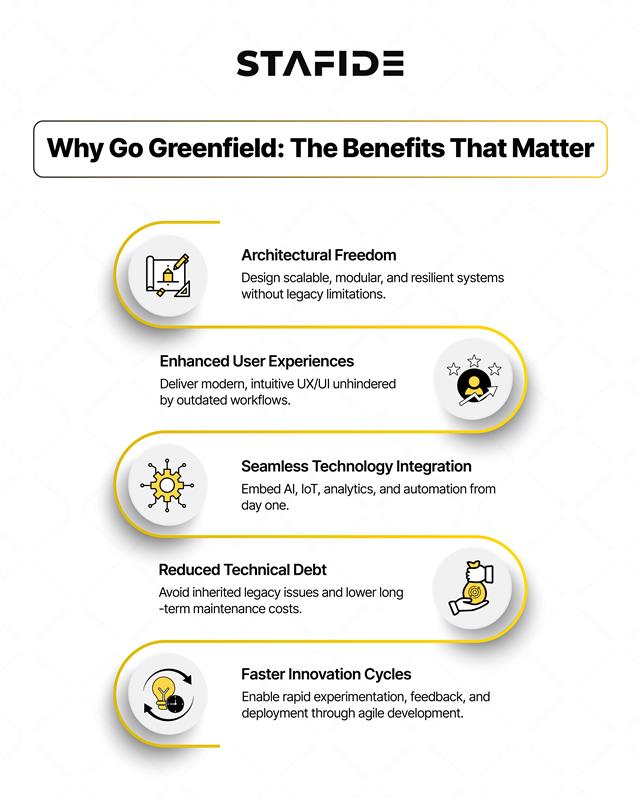
Key Benefits of Greenfield Development
Choosing a greenfield approach offers multiple strategic benefits:
- Architectural Freedom: Design modular, scalable, and resilient systems without being constrained by outdated frameworks.
- Enhanced User Experiences: UX/UI can be tailored to modern user expectations, unbound by legacy workflow limitations.
- Seamless Technology Integration: AI, IoT, analytics, and automation can be embedded from day one.
- Reduced Technical Debt: Starting fresh avoids inherited problems, lowering long-term maintenance and upgrade costs.
- Faster Innovation Cycles: Agile practices and iterative development enable rapid experimentation, feedback, and deployment.
These benefits empower organizations to move from incremental improvements to transformative change, giving them a competitive edge in both operations and customer engagement. To see greenfield development in action, let’s explore a real-world example demonstrating its impact.
Case Study: Digital Twins in the Energy Sector (2025)
Overview
Energy leaders like Siemens, Shell, and Duke Energy adopted greenfield digital twin platforms to modernize operations without dependence on legacy systems.
What They Implemented
- Siemens: Digital twins for gas turbines to enable real-time monitoring and predictive maintenance.
- Shell: Virtual refinery models to simulate processes and optimize production.
- Duke Energy: Grid-level digital twins to predict failures and support renewable integration.
Impact
- More efficient and reliable asset performance.
- Safer operations through scenario simulation.
- Increased agility and innovation across energy infrastructure.
- Stronger readiness for renewable energy adoption.
(Source: Digital Twin in the Energy Sector)
Impressive results aside, achieving greenfield success is not without challenges.
Challenges Organizations Must Navigate
While greenfield development offers substantial benefits, it also presents notable challenges:
- Talent and Expertise:
Greenfield development demands specialized skills, including developers, architects, UX designers, DevOps engineers, and security experts. Many organizations struggle to find or retain this talent, making capability gaps a major barrier. - Investment and Timing:
Building from scratch requires significant financial commitment, structured planning, and disciplined execution. Without strong oversight, projects can face delays, cost overruns, or misaligned expectations. - Security and Compliance:
New systems must embed governance, data protection, identity management, and regulatory compliance from day one. Any oversight at the architecture stage can introduce long-term risks. - Change Management:
Greenfield initiatives often introduce new workflows, tools, and cultural shifts. Teams must embrace change, adapt processes, and encourage collaboration rather than rely solely on having the right technical skills. - Risk of Reinventing the Wheel:
Without clear objectives and a validated business case, organizations may unintentionally recreate existing inefficiencies, or build solutions that fail to deliver meaningful improvement.
Recognizing these challenges highlights why a disciplined, step-by-step approach is critical to success.
How to Succeed with Greenfield Development
A structured approach increases the likelihood of success for greenfield projects:
- Define Vision and Goals: Establish measurable outcomes, such as improved efficiency, enhanced user experience, or faster time-to-market.
- Choose the Right Architecture and Stack: Adopt cloud-native, API-first, microservices-based designs to enable scalability and flexibility.
- Implement Agile Delivery and DevOps: Streamline development, integrate feedback loops, and ensure continuous improvement.
- Prioritize UX and Design: Prototype, test, and iterate with real users to refine experiences.
- Embed Security and Governance Early: Integrate compliance, identity management, and data protection from day one.
- Launch, Monitor, and Optimize: Focus on delivering value, use analytics to guide improvements, and scale strategically.
Balancing innovative freedom with disciplined execution ensures that greenfield initiatives deliver tangible outcomes.
The Human Layer: People Behind Greenfield Success
Even the most advanced technology cannot succeed without the right people driving it. The human layer is critical to bridging strategy and execution:
- Product Managers & UX Designers: Translate business objectives into user-centered designs.
- Developers & Architects: Build robust, scalable, and adaptable systems.
- DevOps & SRE Engineers: Automate workflows, monitor performance, and manage infrastructure efficiently.
- Security & Compliance Experts: Embed governance and regulatory compliance from the outset.
- Change & Adoption Leads: Foster cultural readiness, engagement, and smooth adoption of new systems.
Organizations that cultivate a collaborative, learning-oriented culture often outperform those that focus solely on technology. Strong teams accelerate delivery, reduce risks, and maximize the impact of greenfield initiatives.
Emerging Trends Shaping Greenfield Development
Greenfield development is being transformed by new approaches and technologies. Organizations are exploring AI-first and autonomous systems, low-code/no-code platforms, edge computing, IoT, serverless and event-driven architectures, and composable ecosystems with robust APIs. Security-by-design practices, including zero-trust and identity-centric frameworks, are becoming standard to ensure applications are protected from inception. These trends reflect the evolving landscape of modern software development.
Building the Future with Greenfield
Greenfield app development is more than a technical initiative; it’s a strategic lever for innovation and long-term growth. By starting fresh, defining clear objectives, building strong teams, and embedding governance from the outset, organizations can unlock the full potential of digital transformation. Investing in future-ready systems rather than patching legacy platforms lays the foundation for operational agility, sustained innovation, and a lasting competitive edge.
Ready to turn your greenfield vision into reality?
STAFIDE can help you build the expert teams needed to accelerate transformation and deliver measurable impact. Let’s talk.